
If you are someone who has just started in tech, then you must have heard about Monolith and Microservice architecture.
And if you’re reading this, there’s a high chance that you didn’t even bother to Google it or ask ChatGPT.
But don’t worry — I’m no different. I was in the exact same place.
After hearing these terms again and again, I finally decided to Google them and do some basic research. And you know what?
It’s not as complicated as it sounds.
Monolith. Microservice.
Big scary words… but very simple ideas.
The names might scare you, but under the hood, these are just design choices — ways to structure your application depending on your requirements and how much you want to scale.
So today, we’re going to break this down in the simplest way possible.
No overcomplicated definitions. No boring theory.
Just clear understanding.
Let’s get started 🚀
MONOLITH
If you came this far, I’m assuming you’re a grown man/woman, and you’ve probably gone grocery shopping at least once in your life.
Monolith architecture is like your shopping cart.
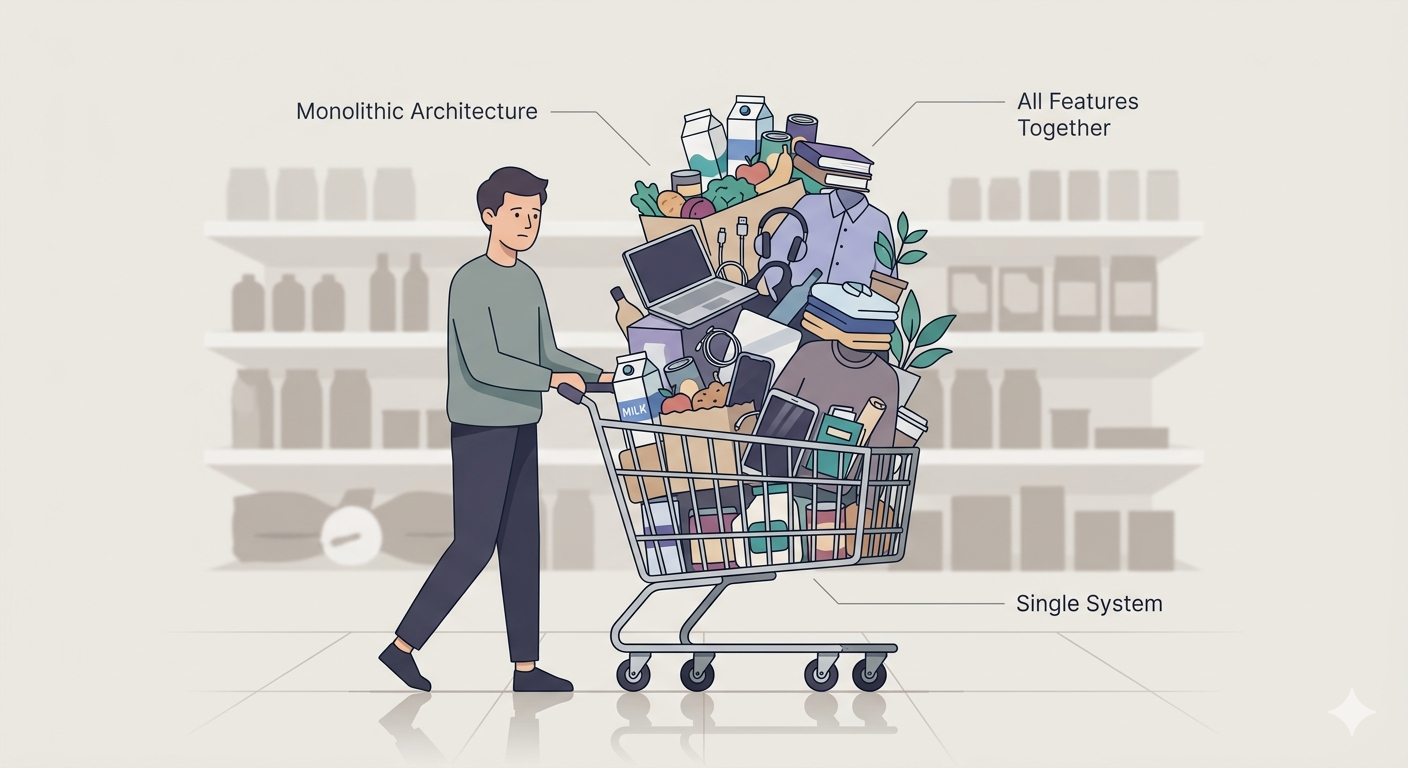
I’m not talking about your digital cart. Imagine the physical carts kept at the entrance of a supermarket, stacked together in a long line. You pick one, walk through the aisles, and keep throwing everything into that single cart.
Everything. In one place.
That’s exactly how monolith architecture works.
You keep every required service of your application in a single codebase, running as one system.
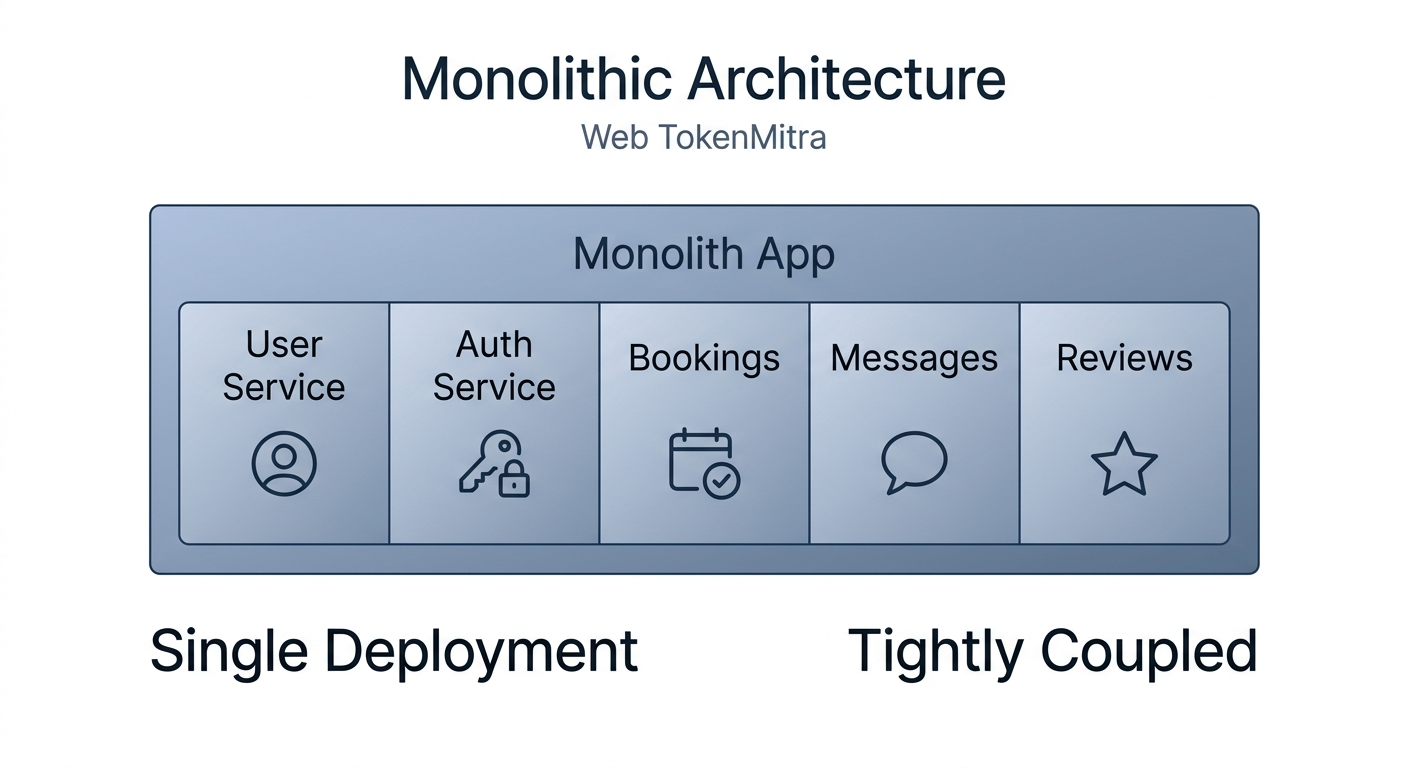
For example, I recently built tokenmitra.online — a queue management and appointment automation system for medical clinics using the MERN stack.
In tokenmitra.online , I used a monolithic architecture. Everything lives in one place:
User, Auth, Bookings, Appointments, Messages — all inside a single application.
This approach is great for beginners (like me). It’s simple to build and easy to manage in the early stages.
But as you might have guessed, everything is tightly coupled.
If one part has an issue or needs scaling, you often end up affecting or scaling the entire application.
Monolith architecture is simple to start but painful to scale...
Problems with Monolith architecture
So if you’re not a web crawler gathering data, I can assume that by now you’ve already guessed the problems with monolith architecture. But still for better clarity, let's discuss the problms:
- Everything is tightly coupled
In a monolith, all your services live together.
- Scaling becomes painful
Let’s say only your booking service is getting heavy traffic. But in a monolith, you can’t scale just that part.
You have to scale the entire application.
- Codebase becomes messy over time
At the beginning, everything feels clean. But as features grows everything becomes messy.
- Slower development speed
If multiple developers are working you can't increase the development speed.
- Hard to adopt new tech
In monolith: everything uses same tech stack.So if you want to use a new database or try a different language , It becomes very hard without affecting the whole system.
- Deployment is risky
Even a small change requires redeploying the whole app.
MICORSERVICE
So let’s move on to microservices.
After everything we just discussed, I don’t think I need to repeat the question: “Why do we need microservices?”
If you can read (and you made it this far), you already have an idea why.
Now let's talk about What is Microservice.
Let’s go a bit deeper into this.
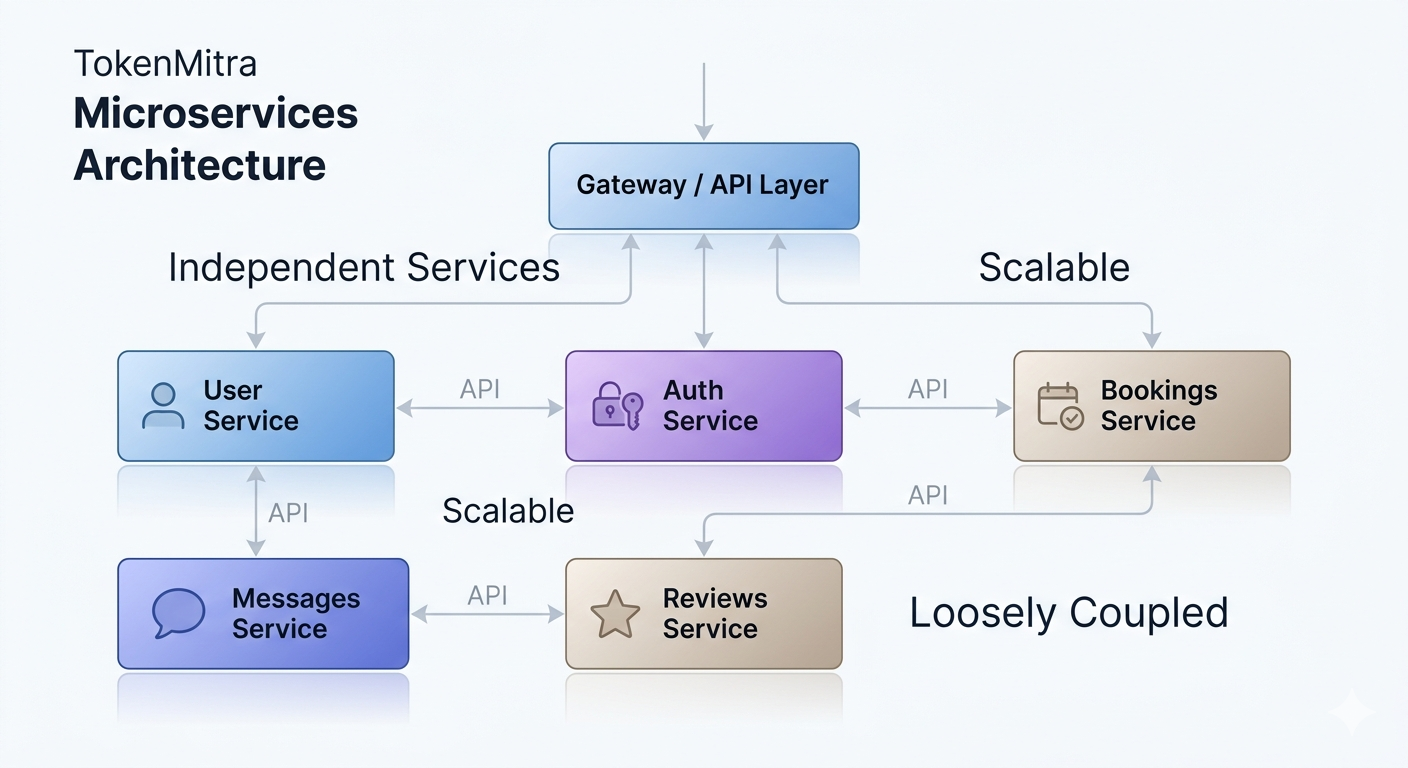
In microservices architecture, every service is independent.
As shown in the image, services like Auth, Booking, Messages, and User are all separate and communicate with each other through APIs.
Each service runs in its own space and handles a specific responsibility.
This makes the system more organized and easier to manage.
These services are loosely coupled.
Which means changes in one service do not directly affect others.
Because of this:
You can scale only the service that needs more resources (for example, booking service during high traffic)
The codebase remains cleaner and more maintainable
Teams can work on different services independently
You can use different technologies for different services if needed
Microservices give you more flexibility and control over your application as it grows.
TLDR
At the end of the day, both monolith and microservices are just different ways to structure your application.
Monolith is simple and a great starting point.
Microservices bring flexibility and scalability as your application grows.
There is no “one size fits all”.
It always depends on your use case, your team, and how big your system is going to be.
Happy Coding